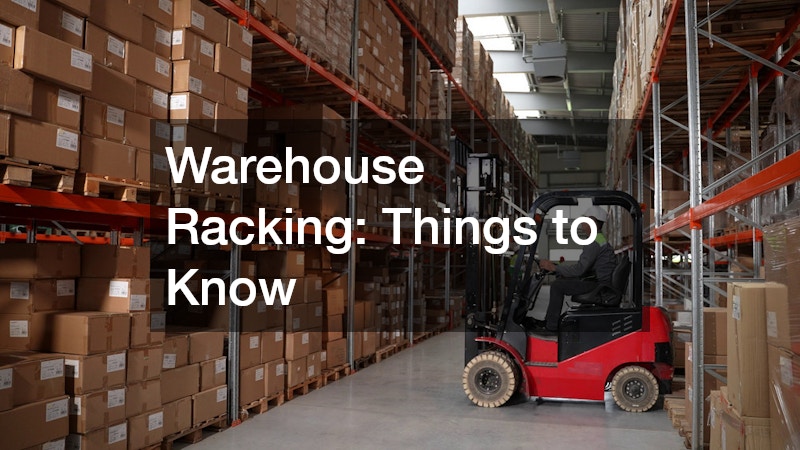

Warehouse racking systems are fundamental structures that enable warehouses to efficiently store and organize their inventory. They are designed to help businesses maximize the utility of their space, allowing easy access to products and goods while maintaining order. The choice of a racking system can significantly impact operational efficiency and storage capacity.
When well-maintained, these systems provide a systematic methodology for managing the storage of various goods.
There are several types of warehouse racking systems, each with unique features tailored to specific storage needs. Pallet racking systems are among the most popular types due to their versatility and ability to accommodate heavy loads. Selective, drive-in, push-back, and flow racks are just a few examples of configurations that can be customized based on the warehouse’s requirements. Proper racking can drastically improve the flow of operations by streamlining the picking process and reducing the time spent searching for items.
The implementation of a warehouse racking system involves careful planning and consideration of several factors. Key elements such as storage density, inventory rotation, and product accessibility must be taken into account. Businesses should also assess the nature of their inventory, weight restrictions, and the volume of goods processed. By incorporating these considerations, companies can select or design a racking system that not only meets their current demands but also accommodates future growth.
Types of Warehouse Racking Systems
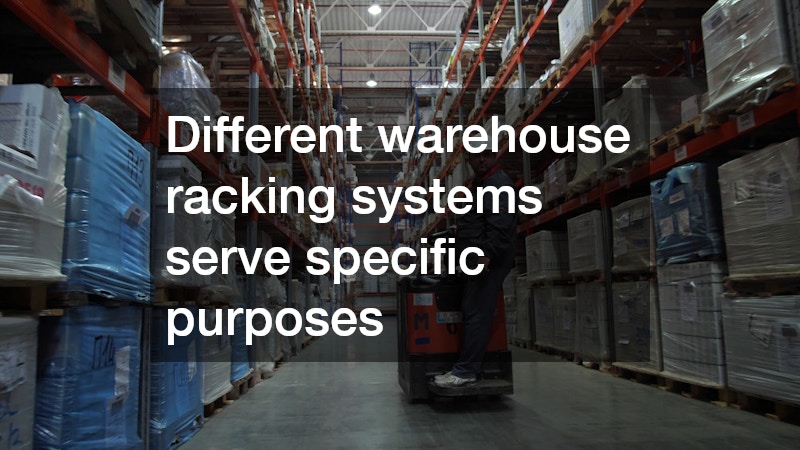
Different warehouse racking systems serve specific purposes and can be customized to suit unique storage needs. Selective racking, the most common type, offers flexibility and accessibility as every pallet can be accessed directly without having to shift others. This is ideal for businesses with a high turnover rate of inventory, where access to a variety of pallets is crucial. The system is adaptable and can be configured to fit various warehouse layouts and ceiling heights.
Drive-in racking is optimal for high-density storage where the stock is stored and retrieved on a ‘last in, first out’ (LIFO) basis. This system is perfect for uniform products or bulk storage where longer-term storage and fewer SKUs are common. Push-back racking, on the other hand, operates on a ‘first in, last out’ (FILO) basis, providing both high-density storage and better access to different SKUs compared to drive-in racking. This method is useful in scenarios where a balance between storage space and selectivity is required.
Flow racking offers a ‘first in, first out’ (FIFO) storage solution using gravity rollers, making it highly efficient for industries with a fast-moving inventory. These systems are useful in warehouses where time-sensitive products are stored, as it ensures that the oldest stock is used first, reducing spoilage and waste. Each type of racking system offers distinct advantages, and the correct selection depends on the specific requirements of the warehouse operations, including throughput, SKU variety, and product handling methods.
Factors to Consider When Choosing Racking Systems
Selecting an appropriate warehouse racking system involves evaluating several critical factors to ensure efficiency and safety. One such consideration is the available space within the warehouse, which dictates the design and layout of the racking system. Maximizing vertical space can lead to significant improvements in storage capacity without the need for larger premises. Additionally, facility constraints like lighting, ventilation, and access to fire safety measures must be respected to maintain a safe working environment.
Cost implications and budget constraints also play a significant role in determining the appropriate racking system. While initial costs may be a deciding factor, long-term benefits such as reduced labor costs, improved storage efficiency, and minimized handling risks should be considered. Moreover, the implementation of scalable racking systems that can be adapted as business needs evolve can result in better returns on investment. It is essential for businesses to balance their financial considerations with operational necessities to optimize their racking solutions.
Benefits of Efficient Warehouse Racking
The introduction of efficient warehouse racking systems offers numerous benefits, leading to improved operational effectiveness and profitability. An effective racking system enhances the organization, making products more accessible and easier to retrieve. This results in faster picking times, reducing labor costs, and expediting the order fulfillment process. Improved organization also lowers the incidence of misplaced or lost inventory, which can significantly impact profitability.
Additionally, maximizing storage space without the need for warehouse expansion provides substantial cost savings to businesses. Efficient racking systems make it possible to increase throughput and manage larger inventories without increasing the warehouse footprint. This scalability not only aids in accommodating business growth but also optimizes the use of available space, leading to enhanced operational efficiencies and reduced overhead costs.
Maintaining and Improving Warehouse Racking Systems
Regular maintenance of warehouse racking systems is crucial to ensure their longevity and safety. Routine inspections help identify wear and tear, structural damage, or other issues that could compromise the efficiency and safety of the racking system. Businesses should implement scheduled audits and maintenance programs to address potential problems before they escalate. Moreover, repair and strengthening of damaged components should be prioritized to prolong the lifespan of the racking infrastructure.
Technological advancements offer innovative ways to enhance the functionality of warehouse racking systems. Automated systems and inventory management software can track product locations and improve picking accuracy, freeing up human resources for other tasks. The integration of smart technology in racking systems provides added value by optimizing space utilization, increasing throughput, and offering detailed insights into inventory dynamics. As the need for efficient storage solutions continues to grow, businesses must leverage technology to remain competitive.